There’s a strange thing about alcohol in our culture. It can be so woven into everyday life that we barely notice it. We drink at weddings and football games. We drink on vacation. We drink on boats. We drink with friends. And somewhere along the way, we also started joking about parents needing wine just to survive parenting.
Melissa and I live in the Annapolis area, where boating culture and drinking culture are particularly intertwined. When I first moved here, I remember being stunned by how much alcohol showed up in situations where parents were still very much “on duty.” Kids’ sporting events, Halloween, boating and neighborhood gatherings could all include drinking. But this isn’t really an Annapolis problem. It’s part of a much bigger conversation about the role alcohol plays in our lives.
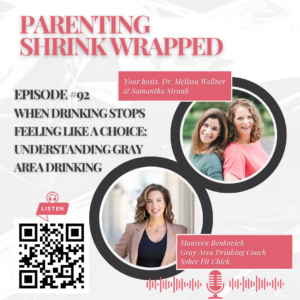
That’s why we invited Maureen Benkovich, a gray area drinking coach and host of the Sober Fit Life podcast, to join us on Parenting Shrink Wrapped. Maureen helps high-achieving adults examine and change their relationship with alcohol without requiring labels or a dramatic “rock bottom” moment.
What Is Gray Area Drinking?
When most of us think about someone having a problem with alcohol, we tend to picture the extreme. Maybe they’ve lost their job, damaged relationships, gotten into legal trouble, or reached some obvious breaking point.
But there’s a huge space between “I don’t have a problem” and that version of alcohol dependence.
That’s the gray area.
Maybe you’re successful professionally. You’re taking care of your family. You’re exercising. You’re showing up to work. On paper, everything looks fine. But privately, you’re starting to wonder why you’re thinking about drinking so much. Maybe you regularly intend to have one glass and have three. Maybe you’re waking up at 2:00 or 3:00 in the morning feeling anxious and regretting how much you drank. Or maybe alcohol simply doesn’t feel as optional as it once did.
As Maureen explained, you don’t have to decide that you “have a problem” before you’re allowed to make a change. Recognizing that alcohol is no longer serving you can be reason enough.
It’s Not Just About Willpower
We tend to make drinking incredibly personal. If we struggle to cut back, we tell ourselves we don’t have enough self-control or willpower. But Maureen explained that alcohol creates real chemical responses in the brain.
Over time, our brains can begin connecting alcohol with relief, reward, socializing, celebration, comfort and stress reduction. You put the kids to bed after an exhausting day and pour a glass of wine. Your brain begins learning: Long day + wine = relief.
Eventually, the anticipation itself can become part of the cycle. You haven’t even poured the drink yet, but you’re already thinking about how good it’s going to feel.
Understanding that doesn’t remove personal responsibility. It removes some of the shame and allows us to ask a much more useful question: What has my brain learned, and what do I want to teach it instead?
Is That Glass of Wine Really Self-Care?
I loved this part of our conversation because I think so many parents will recognize it.
You’ve finally gotten everyone settled. The house is quiet. You’re exhausted and think, I deserve a drink.
And you probably do deserve a reward. Parenting is exhausting.
But Maureen encouraged us to get curious about whether alcohol is actually providing the self-care we think it is. If drinking affects your sleep, contributes to anxiety, makes you more irritable the following day, or leaves you feeling guilty about how much you drank, is it really doing the job you’ve assigned it?
Maybe what you actually need is food because you haven’t eaten enough. Maybe you’re exhausted. Maybe you need connection, movement, quiet, a bath, a cup of tea, journaling, or simply to go to bed.
The goal isn’t to replace one rigid rule with another. It’s to pause long enough to ask, What do I actually need right now?
Recognize, Replace, Rewire and Renew
Maureen walks clients through what she calls her 4R Method: Recognize, Replace, Rewire and Renew.
First, recognize all the jobs you’ve given alcohol. Maybe you drink when you’re stressed, bored, lonely, celebrating, socializing or trying to relax. Write them down without judging yourself.
Then, replace alcohol with strategies that actually address those needs. If you remove alcohol without replacing the role it has been playing, your brain is naturally going to want to return to what it already knows.
Rewiring happens when you actually experience those situations differently. You go to the party and don’t drink. You spend an afternoon on the boat with friends and bring nonalcoholic drinks. You wake up the next morning and realize, I did that, and I feel really good.
Finally, you renew those choices. Every time you repeat the new behavior, you’re strengthening a different pathway and building a different relationship with stress, celebration, socializing and self-care.
You Don’t Have to Start With “Never Again”
For someone who has spent years associating alcohol with socializing, relaxing or having fun, the thought of never drinking again can feel enormous.
So don’t start there.
Maureen talked about taking a break, experimenting with drinking less, or simply becoming curious about what life feels like without alcohol in certain situations.
She also recommends planning ahead. If you’re going to a wedding without drinking, decide what you’ll order before you arrive. Tell someone you trust what you’re doing. Make sure you’ve eaten. Have an exit plan. Give yourself permission to leave when you’re ready.
And here’s something I loved: Maureen said she’s never had a client wake up after choosing not to drink and say, I really wish I had a drink last night.
There’s something worth paying attention to there.
What Are Our Kids Learning From Us?
Although this episode focused primarily on parents themselves, there’s another layer to this conversation that matters deeply to Melissa and me.
Our kids are watching.
They’re watching how we cope with stress. They’re listening when we say, “I need a drink after this day.” They’re learning what adults do to relax, celebrate, connect and deal with difficult emotions.
That doesn’t mean having a drink in front of your child makes you a bad parent. That’s not what we’re saying at all.
It means our behavior is always communicating something.
And sometimes it’s worth asking ourselves what message we’re sending.
Curiosity Is a Powerful Place to Start
If you’ve ever wondered whether you’re drinking more than you’d like, you don’t need to immediately label yourself. You don’t need to announce that you’ll never drink again. And you certainly don’t need to wait until something terrible happens before you’re “allowed” to reconsider your relationship with alcohol.
You can start with curiosity.
What role does alcohol play in my life?
What am I asking it to do for me?
Is it actually doing that?
And how might I feel if I tried something different?
Those aren’t questions rooted in shame. They’re questions rooted in growth.
And if there’s one thing I believe deeply around here, it’s that our kids aren’t the only ones who are allowed to keep growing.
Listen to the full episode here.